What is a Herniated Disc?
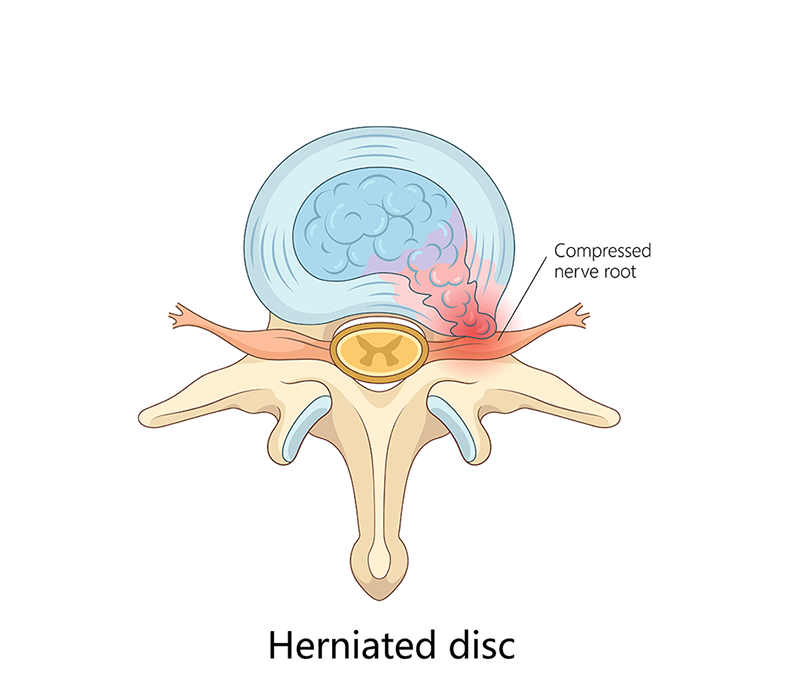
A herniated disc occurs when the soft inner gel of a spinal disc pushes outward through a tear in its tougher outer layer. Many people have a herniation without knowing it, because not every herniation causes symptoms. When the protrusion is large enough to press on a nearby nerve, however, it can cause pain, numbness or weakness in the part of the body that nerve serves. The most common cause is age-related wear and tear: as discs lose flexibility and shock-absorbing ability, they become more prone to tearing. Improper heavy lifting, sudden twisting movements and trauma are other common triggers.
Types of Herniated Discs
Cervical Herniated Disc: In the neck; can cause neck pain and pain, numbness or weakness radiating into the arm.
Thoracic Herniated Disc: In the mid-back; uncommon, but can cause pain wrapping around the chest.
Lumbar Herniated Disc: In the lower back; the most common type, and the leading cause of sciatica.
Causes
Common causes include:
– Age-related disc degeneration
– Sudden trauma or injury
– Repetitive lifting, bending or twisting
– Poor posture over time
– Excess body weight increasing spinal stress
Symptoms
Symptoms vary by location and severity:
– Sharp or burning back or neck pain
– Radiating pain into the arms or legs
– Numbness or tingling
– Muscle weakness
– Difficulty standing or walking
Diagnosis
Evaluation may include:
– Physical exam testing reflexes, strength and sensation
– MRI, the most useful imaging to visualize a herniation
– CT scan for detail on bone and disc spaces
– X-rays to rule out other causes
– Nerve conduction studies to assess nerve function
Managing Symptoms
A herniated disc does not always require surgery. In many cases symptoms improve over weeks to months with rest from aggravating activities, gentle movement, heat and ice, and over-the-counter anti-inflammatory medication. See a doctor promptly if you experience severe pain, progressive weakness, or loss of bladder or bowel control, and talk to your doctor if symptoms persist or keep returning.
Prevention
Lifting with the legs rather than the back, avoiding sudden twisting under load, maintaining good posture, strengthening the core, keeping a healthy weight and avoiding tobacco all reduce the stress on spinal discs and the risk of herniation.
Conservative Treatment Options
Non-surgical treatments are designed to reduce inflammation, relieve pain and restore normal movement:
– Rest and activity modification: temporarily avoiding activities that aggravate symptoms while maintaining gentle movement
– Anti-inflammatory medications (NSAIDs) to reduce inflammation and pain
– Physical therapy: targeted exercises to improve strength, flexibility, posture and spinal support
– Epidural steroid injections to reduce inflammation around irritated nerves
– Heat and ice therapy to manage pain, muscle tension and inflammation
Surgical Treatment Options
Surgery may be considered when symptoms persist, worsen or continue to interfere with daily life despite conservative care. The goal is to relieve pressure on the affected nerve. At NextGen Spine Center this is done minimally invasively: an endoscopic or percutaneous discectomy removes only the portion of the disc pressing on the nerve through a small incision, and a partial laminectomy creates additional space when needed. No fusion, no implanted hardware, and patients return home the same day. Learn more about herniated disc treatment at NextGen.
Why We Recommend Regenaplasty
For patients whose herniation requires surgical decompression, we often recommend Spinal Regenaplasty over a standard discectomy alone. Removing the disc material pressing on the nerve relieves pressure, but the tear in the disc wall that allowed the herniation is left to heal on its own — a common source of recurrent herniation at the same level. Regenaplasty combines that same minimally invasive surgical correction with regenerative biologics placed directly at the disc and surgical site, supporting a stronger tissue repair and working to reduce the risk of re-herniation. Learn more about Spinal Regenaplasty.
Frequently Asked Questions
Or contact us at any time
No. A bulging disc protrudes without rupturing; in a herniated disc the inner material has escaped through a tear in the outer layer.
Yes. Many improve with conservative care over weeks to months. If pain persists or nerve symptoms worsen, a minimally invasive procedure may be needed.
If you experience severe pain, progressive weakness, or loss of bladder or bowel control, or if symptoms have not improved after several weeks of conservative care.
Most people feel better within 6 to 12 weeks with conservative treatment. After a minimally invasive discectomy, patients go home the same day and typically return to normal activities within days to a few weeks.
Our team offers expert diagnosis and comprehensive treatment plans customized to help treat you. These include truly minimally invasive procedures, designed to help our patients return to a pain-free life without fusion or implanted hardware.