What is Degenerative Disc Disease?
Degenerative Disc Disease (DDD) occurs when the intervertebral discs, the soft cushions between the bones of the spine, begin to wear down over time. Despite the name, it is not actually a disease but a natural part of aging for many people. As discs lose hydration and flexibility they no longer provide adequate support or shock absorption, which can lead to chronic back or neck pain, stiffness, inflammation and, in some cases, nerve compression. DDD most commonly affects the cervical (neck) and lumbar (lower back) regions.
At NextGen Spine Center, Dr. Wolff offers advanced, minimally invasive treatments that relieve pain without relying on spinal fusion.
Types of Degenerative Disc Disease
Cervical DDD: Affects discs in the neck, causing neck pain and possible radiating symptoms into the shoulders and arms.
Thoracic DDD: Involves discs in the mid-back. Less common, but can cause back pain and stiffness.
Lumbar DDD: The most frequent type. Affects the lower back and may cause sciatica symptoms if nerves are compressed.
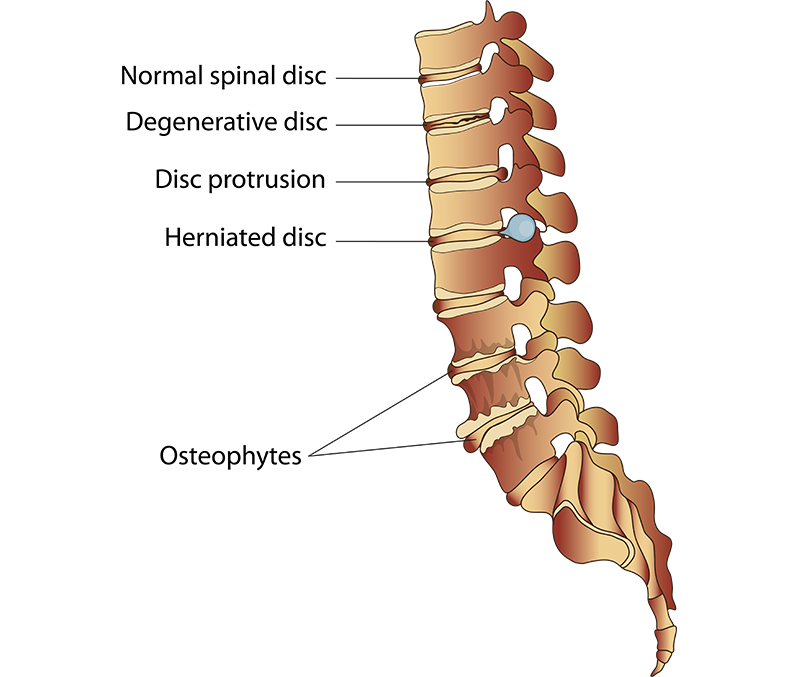
Causes
DDD usually develops from a combination of factors:
– Age-related disc dehydration and breakdown
– Repetitive stress and overuse
– Spinal injuries or trauma
– Genetic predisposition to disc degeneration
– Smoking, which reduces blood flow to the discs
Symptoms
Symptoms vary with the location and severity of degeneration:
– Chronic back or neck pain
– Pain that worsens with bending, twisting or sitting
– Pain that improves when walking or changing positions
– Numbness or tingling in the extremities if nerves are affected
– Muscle weakness
Diagnosis
Diagnosis often includes:
– Medical history review and physical examination
– X-rays to assess disc space narrowing and bone changes
– MRI to visualize disc degeneration and nerve compression
– CT scans or discography in certain cases
Managing Symptoms
Initial management includes rest from aggravating activities, physical therapy, over-the-counter pain medication, and heat or cold therapy. Many people with disc degeneration have flare-ups that settle within weeks. If pain becomes constant, radiates into an arm or leg, or is accompanied by numbness or weakness, it is important to talk to your doctor so the source can be identified and treated.
Prevention
While age-related changes cannot be fully prevented, staying active, avoiding tobacco, maintaining a healthy weight, practicing good posture, using ergonomic workstations and lifting with proper technique all help slow disc degeneration and reduce the load on the spine.
Conservative Treatment Options
Many individuals improve without surgery. Non-surgical options include:
– Nonsteroidal anti-inflammatory drugs (NSAIDs) for pain relief
– Physical therapy to strengthen supporting muscles and improve flexibility
– Activity modification and ergonomic adjustments
– Heat and cold therapy
– Epidural steroid injections to reduce inflammation
Surgical Treatment Options
Surgery may be an option if conservative treatments fail to relieve symptoms or if a degenerated disc is compressing a nerve. Traditional approaches often rely on spinal fusion, which locks the segment together and can accelerate wear at the levels above and below. At NextGen Spine Center we take a different approach: minimally invasive percutaneous discectomy and decompression remove only the disc material or bone pressing on the nerve, preserving the spine’s natural motion, with no fusion, no implanted hardware and same-day discharge.
Why We Recommend Regenaplasty
Degenerative disc disease rarely stays contained to the disc itself. As a disc loses height, it changes the geometry of the entire spinal segment: the foramina through which nerve roots exit narrow, which can progress to foraminal stenosis requiring its own surgical decompression, and the facet joints above and below settle closer together, accelerating cartilage wear that often leads to facet joint syndrome. Treating the disc alone doesn’t stop this chain reaction. Regenaplasty pairs precise surgical correction with regenerative biologics applied directly to the disc and surrounding joint structures, intended to support the body’s natural healing response rather than simply decompressing the segment. Learn more about Spinal Regenaplasty.
Frequently Asked Questions
Or contact us at any time
Aging-related changes cannot be fully prevented, but staying active, avoiding smoking and maintaining good posture can help slow degeneration.
No. Many people have disc degeneration visible on imaging without any symptoms.
Recovery depends on severity and treatment, but symptoms often improve within weeks to months with conservative care. After minimally invasive surgery, most patients go home the same day and begin guided therapy within weeks.
No. Most patients improve without surgery. Surgery is considered when symptoms persist or worsen despite conservative treatment, or when a nerve is being compressed.
Our team offers expert diagnosis and comprehensive treatment plans customized to help treat you. These include truly minimally invasive procedures, designed to help our patients return to a pain-free life without fusion or implanted hardware.