How forty years of innovation on Florida’s Gulf Coast led from awake, outpatient decompression to procedures designed to support the spine’s natural healing.
For most of the twentieth century, spine surgery meant a long incision down the back, muscles stripped from the bone, general anesthesia, days in the hospital and months of recovery. When a disc or joint had degenerated badly enough, the answer was often a fusion: screws, rods and bone graft used to lock the painful segment into a single solid bone. Those operations helped many people, but they also left a great many with scar tissue, stiffness, hardware problems and, over time, wear at the levels above and below a fusion. By the 1980s a small group of surgeons had begun asking a different question: could the spine be treated through an opening the width of a pencil, on an awake patient, who walks out the same day? This article traces the answer to that question, from the earliest keyhole procedures through the two institutions that defined the field, to the newest step in the story, Spinal Regenaplasty at NextGen Spine Center.
Chapter 1: The Idea of Minimally Invasive Spine Surgery
The road to keyhole spine surgery was built in small steps. In 1975, Japanese surgeon Sadahisa Hijikata removed disc material through a narrow tube placed from the side of the spine, without ever opening the spinal canal. In 1977, Wolfhard Caspar and Gazi Yaşargil brought the operating microscope into the field, shrinking incisions and improving precision with the microdiscectomy. In the 1980s, Philadelphia surgeon Parviz Kambin mapped a small anatomical corridor, now known as Kambin’s triangle, through which instruments can safely reach the disc without touching the nerve. Each of these advances chipped away at the same assumption: that a surgeon had to open the back wide to fix what was inside it.
What none of them had yet done was bring these pieces together into a complete, repeatable way of practicing spine surgery: awake patients, local anesthesia, custom instruments, a surgeon who could confirm in real time that the nerve had been freed, and same-day discharge as the rule rather than the exception. That happened on Florida’s Gulf Coast.
Chapter 2: Dr. Alfred Bonati and Awake, Outpatient Spine Surgery
Among the earliest and most influential pioneers of this approach in the United States was Dr. Alfred O. Bonati, an orthopedic surgeon in Hudson, Florida. Dr. Bonati began his career applying arthroscopic techniques to hips, knees and shoulders. He recognized that the same principle, operating through a small opening with a camera and specialized instruments, could shorten recovery and allow procedures to be done on an outpatient basis under local anesthesia rather than general anesthesia.
In the 1980s he applied that thinking to the spine and founded the Gulf Coast Orthopaedic Center, which later rebranded as the Bonati Spine Institute. Dr. Bonati developed a family of patented techniques, the Bonati Spine Procedures, along with custom instruments and one of the first FDA approvals for a Holmium:YAG laser in spine surgery. His patients stayed awake and could talk with the surgical team during the procedure, which allowed the surgeon to confirm in real time that the painful nerve had been freed. The institute reports having performed its procedures tens of thousands of times. Whatever one thinks of any single center, the model Dr. Bonati proved, that spine surgery could be done through tiny openings, on an awake patient, with same-day discharge, changed the expectations of an entire generation of patients and surgeons on Florida’s Gulf Coast and beyond.
Dr. Wolff’s training at the Bonati Institute
The Bonati Institute was also a training ground for a small number of surgeons willing to step off the conventional path, and it is where our founder, Dr. Craig R. Wolff, learned minimally invasive spine surgery. Dr. Wolff graduated magna cum laude from Princeton University in 1986, earned his medical degree at the University of Chicago Pritzker School of Medicine, where he was inducted into the Alpha Omega Alpha medical honor society, and completed his orthopedic surgery residency at the University of California, San Francisco. In the 1990s, when nearly all spine training still centered on open surgery and fusion, he chose a fellowship in minimally invasive spine surgery at the Bonati Institute in Hudson, learning to decompress nerves through openings the width of a pencil on patients who were awake and talking.
He stayed on after his fellowship and rose to Assistant Chief of Spine Surgery at the Bonati Institute, working alongside Dr. Bonati during the years the Bonati Spine Procedures were being refined and patented. He has been certified by the American Academy of Minimally Invasive Spinal Medicine and Surgery since 1999. He later served as Assistant Chief of Spine Surgery at Microspine in DeFuniak Springs, Florida, another of the early outpatient minimally invasive spine centers, broadening his experience with a second group of pioneers before returning to the Tampa Bay area.
Chapter 3: Laser Spine Institute Brings Minimally Invasive Surgery to the Mainstream
If Dr. Bonati proved the concept, Laser Spine Institute proved the demand. It was founded in Tampa in 2005 by surgeons James St. Louis and Michael Perry, both of whom worked at the Bonati Institute. LSI took the awake, outpatient, minimally invasive model and scaled it nationally. Within two years it had opened centers in Arizona, Philadelphia and Oklahoma City, and by the mid-2010s it employed about 1,200 people, operated centers in several states and had broken ground on a $56 million headquarters and surgery center in Tampa.
Dr. Wolff: Chief of Spine Surgery in Tampa Bay
Dr. Wolff was part of that story from the beginning. When the founders launched Laserscopic Spine Centers of America in St. Petersburg in 2004, the venture that grew into Laser Spine Institute, Dr. Wolff served as its Chief of Spine Surgery. When the practice became Laser Spine Institute the following year, he served as the Chief of Spine Surgery at the Tampa Bay location, the flagship center from which the company’s techniques, protocols and surgeon training radiated to its other sites. In that role he was responsible for the surgical program at the highest-volume outpatient spine practice in the country, performing and supervising minimally invasive decompressions across a wide range of conditions, from herniated discs and spinal stenosis to patients arriving with hardware and pain from failed fusions performed elsewhere.
LSI’s contribution was less about a single new technique than about changing the conversation. Its advertising reached millions of patients who had been told fusion was their only option, and it introduced the vocabulary of minimally invasive spine surgery, small incisions, no hospital stay, walking the same day, to the general public. Over its lifetime the company performed roughly 100,000 procedures, and in doing so it trained a large cohort of surgeons, nurses and staff in high-volume outpatient spine care. Many of the surgeons practicing endoscopic and minimally invasive spine surgery in Florida today passed through its doors.
Leading the surgical program at that scale also gave Dr. Wolff a perspective few surgeons have. He could see, over years of follow-up and across an enormous patient population, which patients did well over the long term and which did not, and he came to recognize what was still missing from even the most precise decompression: a way to help the degenerated disc, joint or ligament actually heal. That observation became the seed of NextGen Spine Center.
Chapter 4: Spinal Regenaplasty and NextGen Spine Center
Every generation of minimally invasive surgery described so far shared one limitation. Whether the surgeon removed a disc fragment through a six-inch incision or a six-millimeter one, the operation took something away. It relieved the pressure on the nerve, but it did nothing to restore the health of the disc, joint or ligament that had degenerated in the first place. The newest chapter in minimally invasive spine surgery is about addressing that gap.
Regenerative medicine uses the body’s own healing biology, concentrated platelets that release growth factors, cells drawn from bone marrow or fat, and other biologics, with the goal of supporting the body’s natural healing response. Over the past fifteen years these therapies have moved from the laboratory into human clinical trials for degenerative disc disease and facet joint pain. The research is encouraging: randomized trials of platelet-rich plasma have shown improvements in pain and function that persisted at one year, and cell-based therapies have demonstrated good safety profiles and functional gains in early studies. Researchers are also candid that the field is still young, and that larger, longer trials are needed before any single regenerative therapy becomes a universal standard. At NextGen Spine Center we share that honesty with our patients: regenerative biologics are a powerful complement to a well-performed decompression, not a substitute for it.
Correcting the problem, then helping the body heal
NextGen Spine Center in Tampa Bay, Florida, was founded by Dr. Wolff, and in a real sense the center is the next step in the lineage this article has traced. He trained under Dr. Bonati and served as Assistant Chief of Spine Surgery at the Bonati Institute, then served as Chief of Spine Surgery at Laserscopic Spine Centers of America and at Laser Spine Institute’s Tampa Bay location. He is board certified in orthopedic surgery by the American Board of Physician Specialists and brings more than 27 years of specialized experience in minimally invasive laser spine surgery. Few surgeons anywhere have spent as many years inside the two institutions that defined awake, outpatient, motion-preserving spine surgery, and NextGen was founded to carry what he learned there forward. Our approach is built on a simple conviction: the goal of spine surgery should be to relieve pain at its source while preserving the natural movement of the spine, and to support the long-term health of the spine, not just relieve compression.
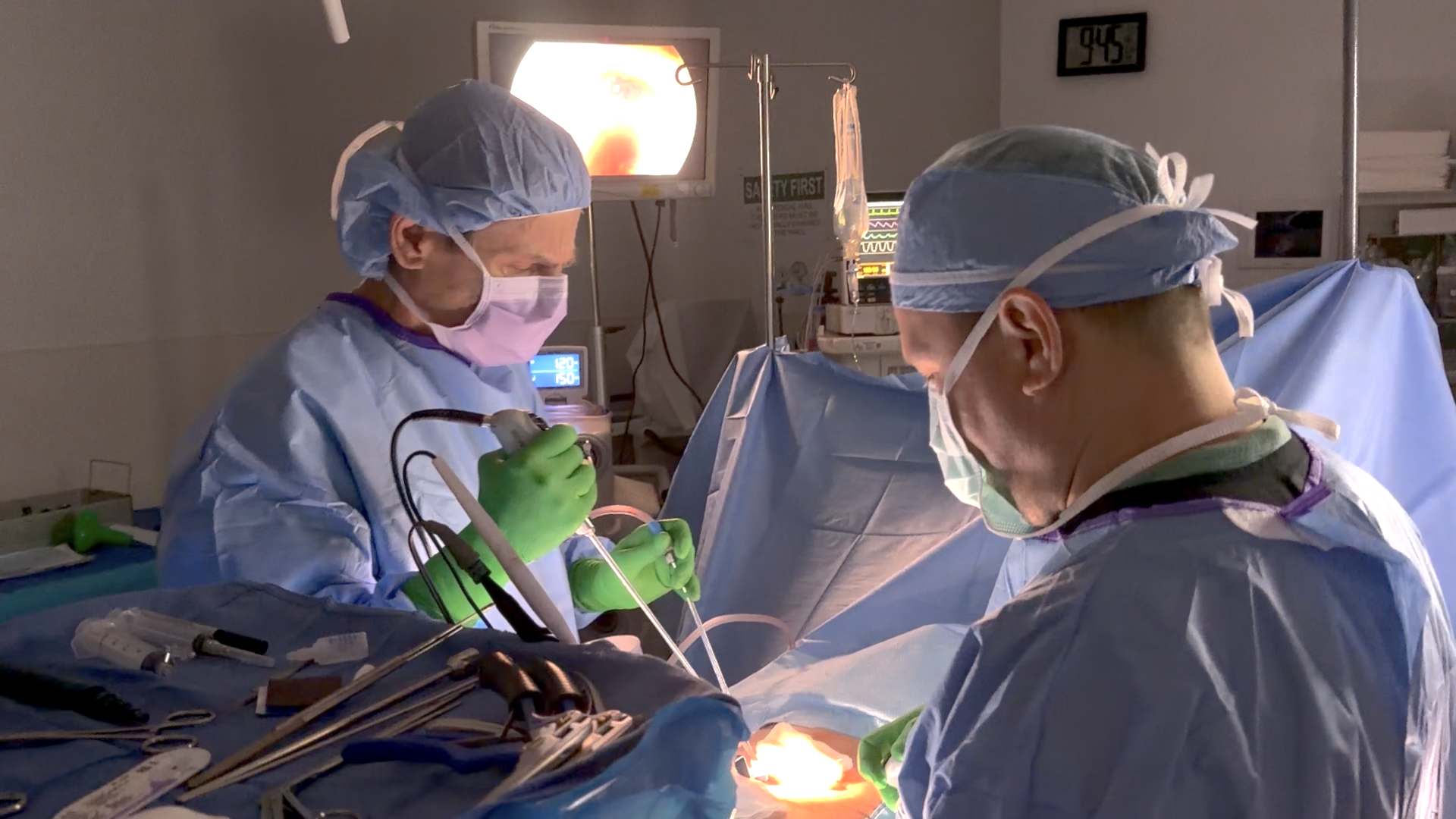
That conviction is expressed in Spinal Regenaplasty, a technique developed at NextGen that combines precise minimally invasive correction with regenerative medicine in a single, coordinated plan. The process has four phases. First, advanced imaging and biomechanical analysis identify the true structural cause of the pain rather than treating symptoms alone. Second, the problem is corrected using truly minimally invasive techniques such as endoscopic decompression, foraminotomy, minimally invasive laminectomy or percutaneous discectomy, without fusion and without implanted hardware. Third, regenerative biologics, which may include cell-based or growth-factor therapies, are introduced at the surgical site to support the body’s natural healing of the treated tissue. Fourth, a structured rehabilitation program restores mobility and strength. Procedures are performed in an ambulatory surgery center under IV sedation, and most patients go home the same day and begin guided physical therapy within weeks.
Spinal Regenaplasty is used for degenerative disc disease, herniated discs, spinal stenosis, spondylolisthesis, cervical disc disease, facet joint syndrome, radiculopathy, lumbar instability and failed back surgery. Because it avoids fusion, it also avoids the adjacent-segment wear that fusion can set in motion, and because it avoids hardware, there is nothing to loosen, migrate or irritate years later. For patients who already have hardware from a previous surgery, NextGen also offers minimally invasive hardware removal.
Am I a candidate?
Patients who benefit most typically have neck or back pain lasting more than three to six months that has not responded to conservative care, pain that interferes with daily life, or radiating pain, numbness, tingling or weakness in an arm or leg. A consultation with imaging review is the best way to find out.
Where the Story Goes Next
Minimally invasive spine surgery has traveled a remarkable road in forty years: from a handful of surgeons experimenting with narrow tubes and microscopes, to awake patients walking out of a Hudson surgery center the same afternoon, to a national network that made “minimally invasive” a household phrase, and now to procedures that pair that precision with the body’s own capacity to heal. Each generation built on the last, and Dr. Wolff has had a hand in each of the last three chapters, as a fellow and Assistant Chief of Spine Surgery at the Bonati Institute, as Chief of Spine Surgery at Laser Spine Institute in Tampa Bay, and now as the founder of NextGen. Dr. Bonati showed that spine surgery could be small and outpatient; Laser Spine Institute showed that patients across the country wanted it that way; and Spinal Regenaplasty aims to go further, relieving pain while supporting the body’s own healing.
At NextGen Spine Center, we consider ourselves part of that lineage and responsible for carrying it forward. If you have been told that fusion is your only option, or if you are simply tired of living with pain, we would welcome the chance to review your imaging and talk through whether a truly minimally invasive, regenerative approach is right for you. Call (888) 326-3138 or email info@nextgenspinecenter.com.
This article is for general education and is not a substitute for individual medical advice. Every patient is different; results and recovery times vary, and a physician can determine whether any procedure is appropriate for you. Regenerative biologic therapies for spinal conditions continue to be studied in clinical trials.
No responses yet